Are You in Crisis Now?

What to Expect From CBEM Crisis Intervention Services

Knowing what to expect can make it easier to take the next step. This page explains how CBEM services begin, what happens throughout the process, and how our team works with individuals, families, caregivers, and care partners.

CBEM crisis intervention services are accessed through participating California Regional Centers. If you are seeking support for yourself or someone you care for, begin by contacting your Regional Center Service Coordinator/Social Worker. If you are unsure which Regional Center serves your community, we can help you find the appropriate contact.

Regional Center Service Coordinators and other authorized partners can find referral information and next steps in the Partner Referral Pathway below.

Step 1: Referral

What to Expect During the First 24–72 Hours

After CBEM receives an authorized referral from a participating Regional Center, a member of our team will contact the individual, family, or designated representative to introduce CBEM, explain our services, and answer initial questions. We will also provide information about accessing crisis-response support and schedule an intake appointment based on the individual’s needs and availability.

How We Coordinate With Your Regional Center

During this time, CBEM connects with the Service Coordinator to confirm the referral, review available background information, and clarify immediate concerns and priorities. We also communicate anticipated next steps and establish appropriate access to service information in accordance with authorization, consent, and privacy requirements.

A Service Coordinator/Social Worker may participate in the intake when requested or appropriate. CBEM adapts the coordination process to the individual’s preferences, support needs, and the Regional Center’s established practices.

Crisis Intervention Services

Step 2: Assessment and Intake

The intake is an opportunity for CBEM to learn about the individual; their experiences, strengths, preferences, current needs, and the people involved in their support. We listen to the individual and collaborate with families, caregivers, providers, and other trusted care partners to understand factors that may be contributing to the current situation.

Our team guides participants through required paperwork, authorizations, and the service process. We explain CBEM’s role, how we will work together, and what the individual and support team can expect throughout services.

The information gathered during intake provides the foundation for an individualized support plan. Strategies are developed collaboratively and reflect the person’s goals, circumstances, communication needs, environment, and existing resources.

Step 3: Active Support

During active crisis intervention services, CBEM works with the individual and their support team to address immediate concerns, strengthen existing supports, and promote greater stability over time.

Services are provided in settings relevant to the individual’s daily life, which may include the home, school, day program, or community. Remote support may also be used when appropriate and authorized.

Our teams coordinate with the individual, family, caregivers, Service Coordinator, providers, and other care partners. Together, we identify factors that may contribute to distress or instability, develop practical behavioral support strategies, coach caregivers and support staff, and connect the individual with relevant community resources.

Individuals enrolled in active CBEM services have access to crisis-response support 24 hours a day, seven days a week. Support may be provided by phone or in person, depending on the individual’s needs, location, circumstances, and immediate safety considerations.

Services generally last between three and twelve months. The timeline is reviewed based on the individual’s progress, stability, continued needs, and applicable service authorization. CBEM communicates regularly with the individual and care partners about progress and next steps.


Step 4: Transition and Stability

Transition planning begins before active services conclude. CBEM works with the individual, support team, and Service Coordinator to establish a timeline, review progress, and prepare for continued support after CBEM services.

We develop a written transition plan that identifies effective strategies, available resources, ongoing support needs, and recommended next steps. The individual and authorized care partners receive a crisis support plan that can be used if concerns re-emerge.

CBEM completes two follow-up contacts during the transition period to review how the plan is working, discuss changes in the individual’s needs, and address any remaining coordination needs.

Services conclude when the individual has demonstrated increased stability, the support team is prepared to use the established strategies, and transition goals have been addressed. If needs arise again after services end, the individual or family may contact their Regional Center Service Coordinator to discuss available support and, when appropriate, a new referral to CBEM.

Transition and Stability

Find Your Regional CBEM Team

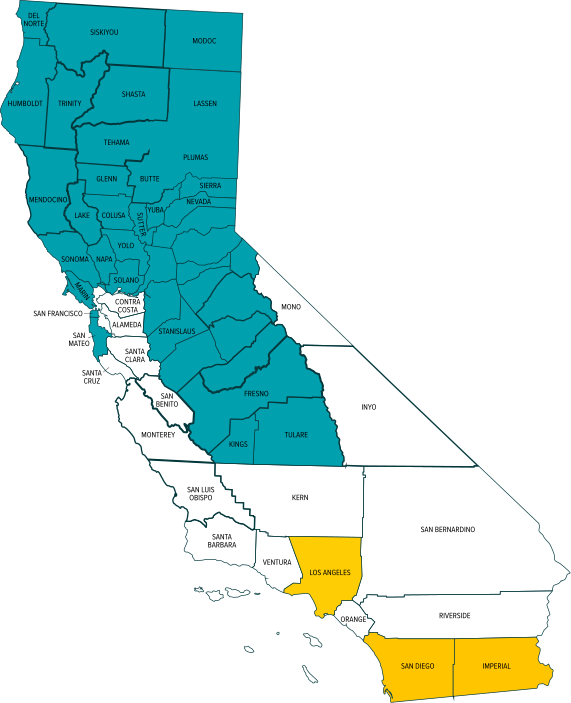
CBEM works out of 18 offices across California, from the North to Southern California. Each office partners with the Regional Centers in its area, so the team supporting you is local to you. Not sure which Regional Center serves your area? Find your Regional Center through the California Department of Developmental Services.

Northern California

Click on a Regional Center for phone numbers and areas served

Areas Served:
Grass Valley, Placerville, Sacramento, South Lake Tahoe, Truckee, Woodland, Yuba City
Phone Numbers:
Nevada 530.272.4231
Placer 916.437.6900
Sacramento 916.978.6400
Alpine 530.314.5970
El Dorado 530.626.1353
Sierra 530.587.3018
Yolo 530.666.3391
Yuba / Colusa / Sutter 530.674.3070
Areas Served:
Fresno, Merced, Tulare, Kings, Madera, Mariposa
Phone Numbers:
Fresno 559.276.4300
Merced 209.723.4245
Visalia 559.738.2200
Areas Served:
Butte, Shasta, Glenn, Modoc, Trinity Lassen, Plumas, Tehama, Siskiyou
Phone Numbers:
Chico 530.895.8633
Redding 530.222.4791
Areas Served:
Marin, San Francisco, San Mateo
Phone Numbers:
San Rafael 415.446.3000
San Francisco 415.546.9222
San Mateo 650.574.9232
Areas Served:
Napa, Solano, Sonoma
Phone Numbers:
Napa / Solano 707.256.1177
Santa Rosa 707.569.2000
Areas Served:
Mendocino, Lake, Humboldt, Del Norte
Phone Numbers:
Ukiah 707.462.3832
Fort Bragg 707.964.6387
Lakeport 707.262.0470
Eureka 707.445.0893
Crescent City 707.464.7488
Areas Served:
San Joaquin, Stanislaus, Amador, Calaveras, Tuolumne
Phone Numbers:
Stockton 209.473.0951
Modesto 209.529.2626
San Andreas 209.754.1871

Southern California

Click on a Regional Center for phone numbers and areas served

Areas Served:
Harbor, Torrance, Long Beach, Bellflower
Phone Numbers:
Torrance 310.540.1711
Areas Served:
San Fernando , Santa Clarita, Antelope Valley
Phone Numbers:
Chatsworth 818.778.1900
Santa Clarita 661.775.8450
Antelope Valley 661.945.6761
Areas Served:
El Monte, Foothill, Pomona
Phone Numbers:
El Monte 909.620.7722
areas served

Referring a Client to CBEM

For Regional Centers and Authorized Care Partners

To begin a referral, contact the CBEM office serving your Regional Center’s area. Individuals served by a participating Regional Center may be referred when behavioral or mental health concerns are affecting their safety, stability, daily functioning, or quality of life. CBEM does not impose additional diagnostic, age, or severity requirements beyond Regional Center eligibility.

Healthcare providers and other care partners who believe an individual may benefit from CBEM services should coordinate with the individual’s Regional Center Service Coordinator to initiate an authorized referral.

CBEM typically acknowledges a referral within 24–72 hours. Our team will connect with the Service Coordinator to review the individual’s current needs and relevant history, clarify priorities, and schedule the intake. Authorized partners receive appropriate access to service information and records in accordance with consent, privacy, and Regional Center requirements.